
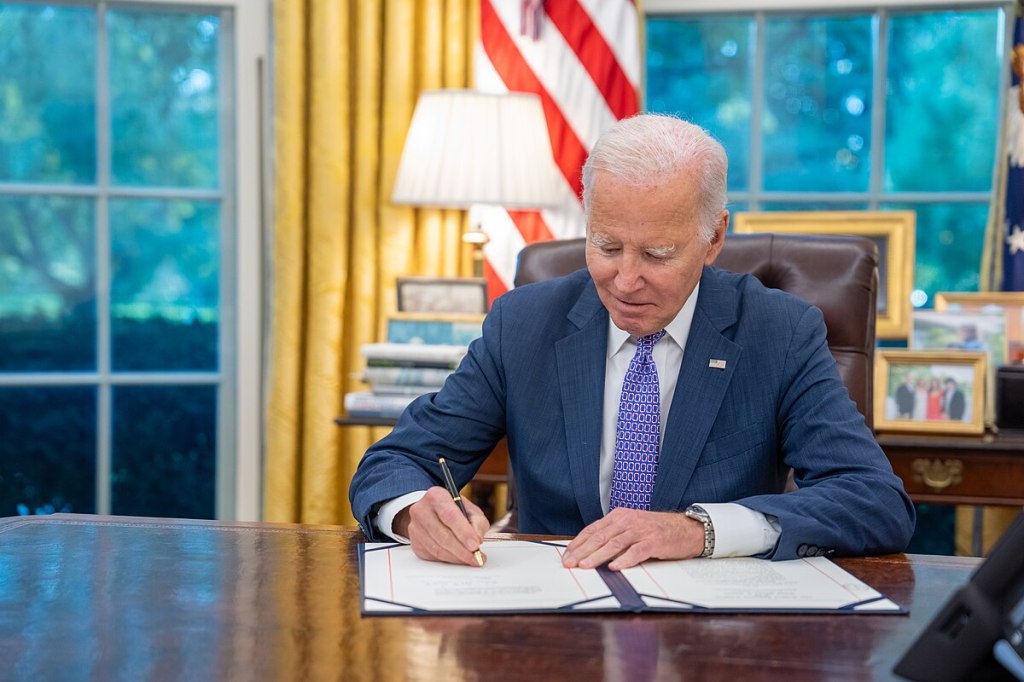
Many presidential elections in the 21st have so far been remarkably close. 2000, 2004, 2016 and 2020 are all examples of this; with the winning candidate in each only winning with a narrow electoral college victory, and on two occasions not even winning the popular vote. Gone are the days of election landslides where candidates like Franklin Roosevelt and Ronald Reagan won close to every state, with a popular vote margin in the double digits.
The upcoming 2024 election is so far continuing the recent trend of close elections; the popular vote is tight and polls in so-called ‘swing states’ even tighter. However, as it stands former President Trump holds a narrow electoral college lead over his Democratic counterpart and is almost certain to outperform his 2020 performance.
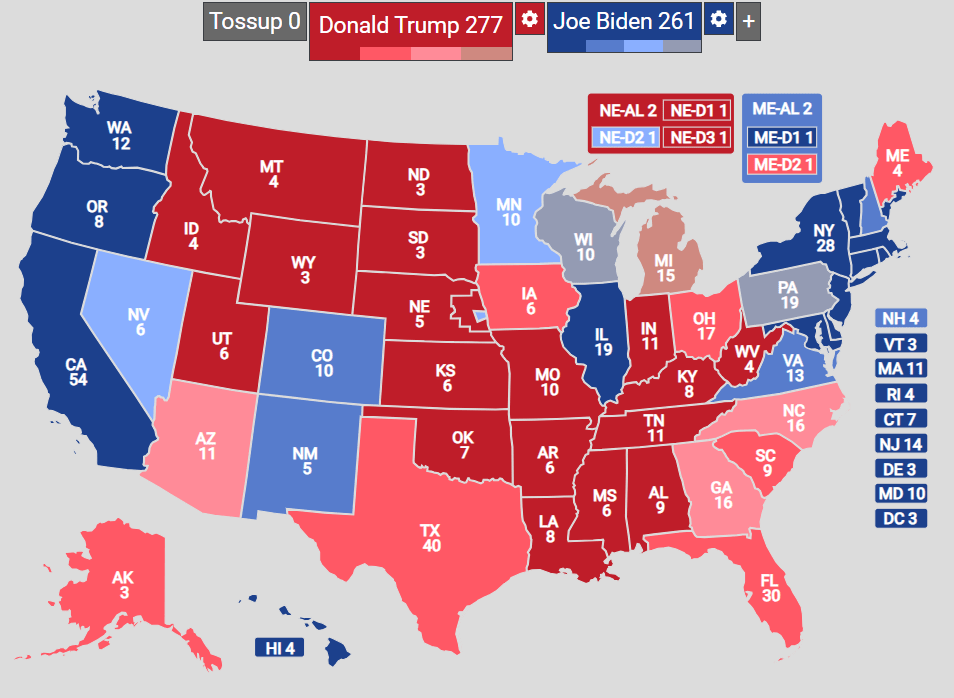
The above image (made with YAPMS) shows an aggregate of polls recently taken in various states; it shows a 16 electoral college vote lead for Trump, though this could easily flip to a Biden victory if polling in Michigan is off by even half a percent.
Clearly, the election will once again hinge on the three marginal rust belt states Pennsylvania, Michigan, and Wisconsin. These are states that went comfortably to Obama during his tenure, Trump won narrowly in 2016, securing his victory over Clinton, and Biden retook in 2020. Each of these three states had multiple polls that gave the state to either Trump or Biden, with neither candidate consistently outperforming the other.
Of course, polls can’t always be trusted; the last two elections seemingly promised landslide victories to the Democrats if the polls were to be trusted, yet instead delivered one Republican victory and one narrow Democrat victory. Based on this, it’d be easy to argue that the current polls also overestimate Democratic support, and so Trump must hold a fairly sizable lead at the moment.
However, polling has much improved since 2016; pollsters have been considering the large polling errors of previous elections. Furthermore, the ‘shy-Republican’ phenomenon that pervaded 2016 and 2020 has largely subsided, as the cultural taboo of being a Trump supporter no longer exists.
This can be seen in the recent 2022 midterms; conservative media pundits heralded the midterms as unstoppable red wave, promising that the voters would return large majorities for the Republicans to the House and Senate. Polling at the time did indicate this to some degree, yet this ‘red wave’ turned out more to be a ‘red trickle’.
Republican candidate Mehmet Oz lost to John Fetterman in Pennsylvania by almost five points, despite polls indicating he’d win by a one-point margin. Fervent Trumpite Kari Lake lost to Katie Hobbs in the Arizona governor election, despite again holding a lead in the polls. Most interestingly, far right conservative Lauren Boebert came within 1,000 votes of losing her district of Colorado-3, despite it historically being a comfortably safe seat for the Republicans.
The main takeaway from the midterms was that support for MAGA-style Republicanism was beginning to fade, especially as it went further and further right on social issues like abortion, but also that polling was a lot more balanced, with even the potential of it being biased against the Democrats, rather than for them.
As such, the current polls for 2024 are anything but certain, and even just the slightest nudge towards Biden will secure him a second term. However, there is one variable that hasn’t been properly accounted for yet: the growing momentum of Robert Kennedy Jr’s independent bid.
Robert Kennedy Jr.

Polling for RFK’s candidacy is still relatively thin, especially on the state level, though his support has so far ranged from around 10-20% of the national vote. The real question on everyone’s mind though is whether RFK is siphoning support from the Democrats or Republicans.
As a former registered Democrat, it’d make sense to assume that RFK is a bigger threat to Biden than he is to Trump. However, his conspiratorial views on vaccines and the COVID-19 pandemic have made him a real draw for Republican voters who have grown tired of Trump.
This is supported by a recent poll done by Quinnipiac University, which showed that Trump loses his national popular vote lead when RFK is included on the ballot. Without RFK, Trump polls at 47% with Biden at 46%, a one-point lead. But when RFK is included as an option, Biden receives 39%, Trump 36% and RFK 22%, giving Biden a three-point lead.
It is also worth noting that when Cornell West, a left-wing philosopher who is also running in the election, is included on the ballot, Biden’s lead is cut to just 1%.
Of course, RFK’s popularity is unlikely to stay so high going into the general election, as voters will slowly drift back to their respective camps as the prospect of throwing the election to the opposition by voting third party becomes more prevalent in their minds. However, with the race looking to be as close as it is, RFK needs only to take a handful more votes away from Trump than he does Biden in key states to hand Biden the victory.
The two photos (in order of appearance) used in this article were taken by the White House and Robert Kennedy Jr. and licensed under public domain and the CC BY-SA 2.0 DEED licence respectively.


 Liberal Lens
Leave a comment