

Liverpool Council convened yesterday to discuss the economic situation of the city. Following a speech by Councillor Billy Marrat, a group of protesters from the ACORN union – who had previously been sat in the public gallery – took to the floor, chanting loudly and holding flags with ACORN logo. One man donned a placard that said, “Boot the Bailiffs.”
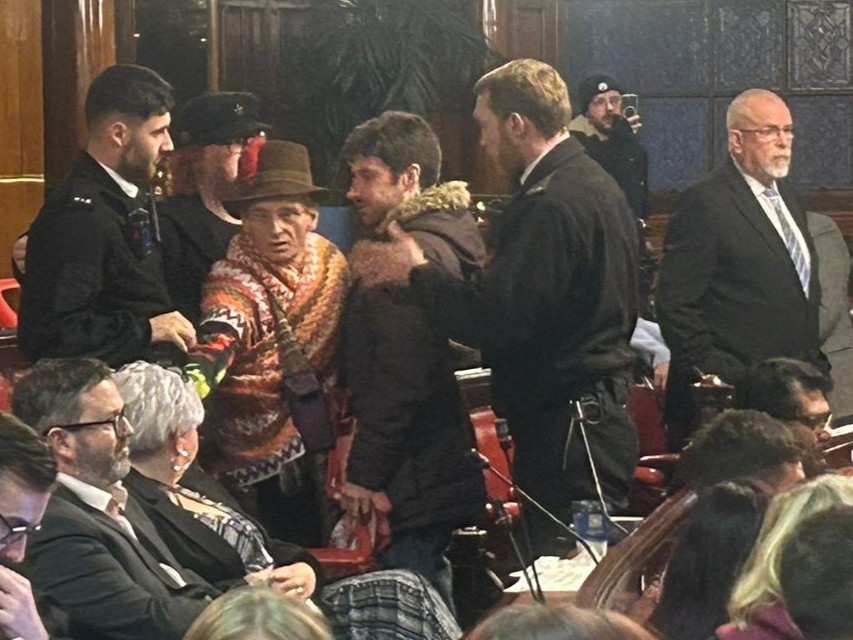
Whilst most of the protesters were stopped by CitySafe officers, the leader of the group was able to make her way to the front of the chambers. There she gave a short speech, much of which I couldn’t discern, calling for an end to the council’s use of bailiffs to collect overdue council tax.
Afterwards, she spoke to Liam Robinson, the leader of city council, showing him a letter and demanding a meeting on the issue of council bailiff use. Robinson agreed, prompting cheers from the protesters.
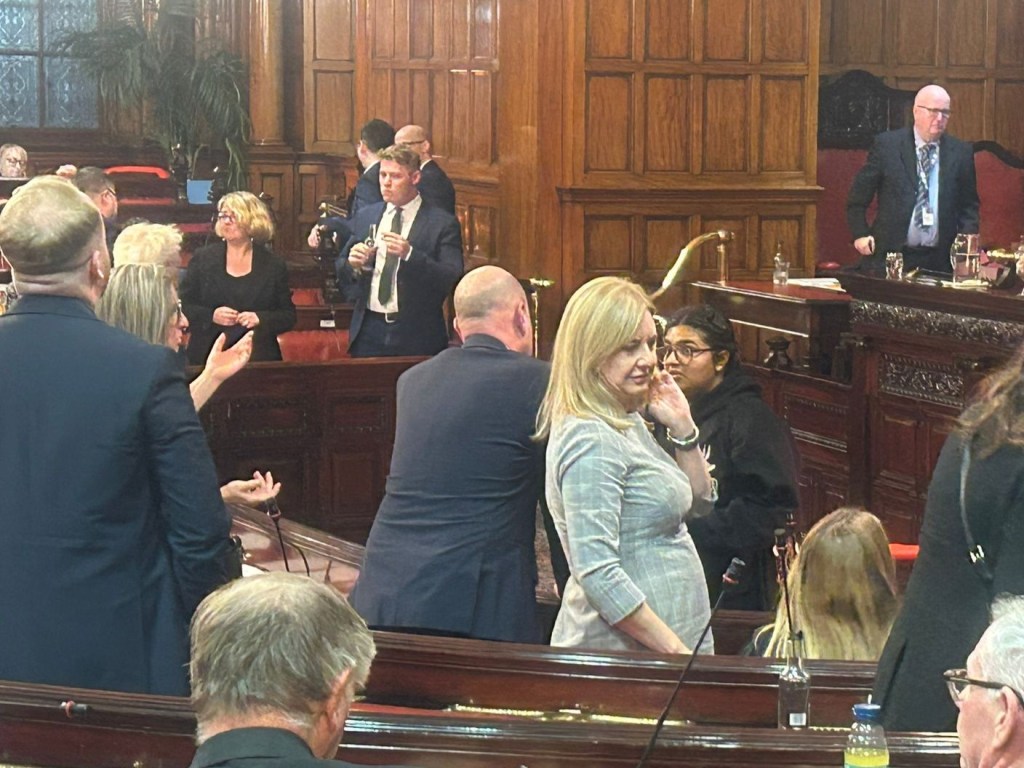
The entire protest was peaceful, and remained so as the protesters willingly left the building, though at one point a man could be heard shouting to one of the CitySafe officers, “take your hands off me… I did not give you permission to touch me.” The group continued their protest outside, holding up banners and handing out leaflets.
Why has ACORN escalated their response?
ACORN is a community union whose stated goal is “a world where all are guaranteed the means to a life and a life worth living.” They focus on issues that affect working class people, like inadequate housing and low pay, employing grassroots organisation and direct action to achieve their aims.
ACORN’s Liverpool branch has recently been pushing for an end to the council’s use of bailiffs to collect overdue council tax. They argue that bailiffs often act aggressively and have little oversight, damaging local communities. A study by Citizen’s Advice from 2018 corroborates this claim, stating that approximately a third of bailiff interactions resulted in illegal behaviour by the bailiff.
Liam Robinson had previously been in contact with ACORN, though there have been no meetings between the two since August. This lack of contact, and the reported 30% increase in bailiff use by local authorities over the last two years, is what prompted the direct action seen yesterday.
According to the Liverpool Echo, Liam Robinson does support some of ACORN’s aims; he says he doesn’t support the use of bailiffs against those who are incapable of paying. He doesn’t support a complete end to bailiff use, however, citing affluent people and organisations who can pay but refuse to.
Opinion: Liverpool Council should reduce its use of bailiffs
The data produced by Citizen’s Advice paints a worrying picture of how bailiffs treat the people they are sent after. Intimidating behaviour is common, and bailiffs often threaten to break into properties, which is not a permitted method of recouping unpaid council tax (though is permitted in some cases like unpaid criminal fines or by court order).
People who experience the poor behaviour of bailiffs are also likely to heightened anxiety and stress follow bailiff interactions. This is especially problematic for those with disabilities, who are more likely to be treated poorly by bailiffs. Clearly, bailiff use comes with a whole host of problems, and its use should be curtailed.
Bailiffs are also an ineffective method of recovering council tax debt. Another report by Citizen’s Advice from 2019 suggests that bailiffs cost about half of what they recover. This severely limits the council’s ability to recover the money it needs for local services.
Limiting council bailiff use is not without precedent; in early 2024 Manchester City Council resolved to stop using bailiffs for households eligible for Council Tax Support. Instead, the council offers alternative payment plans and further financial support. This would be an excellent step forward for the Liverpool Council were a similar plan implemented, as it’d provide some much-needed breathing room for individuals and families struggling to pay for necessities.
However, more comprehensive reforms would be ideal. Instead of relying on bailiffs, it’d be more cost-effective, and less damaging to local communities if unpaid council tax was taken directly from wages. This does have its limits, though; frequent job changes or becoming self-employed might delay debt collection or make it impossible. How much that can be deducted from a pay packet is also limited to 17% (for those earning £250 per week) by national law, meaning large debts or debts coming from those on low incomes could take a long time to recover. Increasing the limit would also require the national government to reform legislation, which is out of the purview of local Liverpool authorities.
Solving wider economic issues like poverty would also help with this situation. Councils are sending bailiffs after people who are often already in economically precarious situations. If the government strengthened social welfare, people would be less likely to be in debt in the first place, making bailiffs unnecessary. Again, this would require national coordination, but there are steps that local councils like Liverpool could take to this end.
Whether ACORN’s upcoming meeting with council leaders bears any fruit remains to be seen, though given previous failures by the council to make positive change, I won’t be holding my breath. ACORN should continue its work pressing authorities on this issue, both in Liverpool and across the country, and hopefully some progress will eventually be made.
The banner image is by SMJ, used under the Creative Commons Attribution-Share Alike 2.0 Generic. All other images were used with permission from the creator.


 Liberal Lens
Leave a comment